
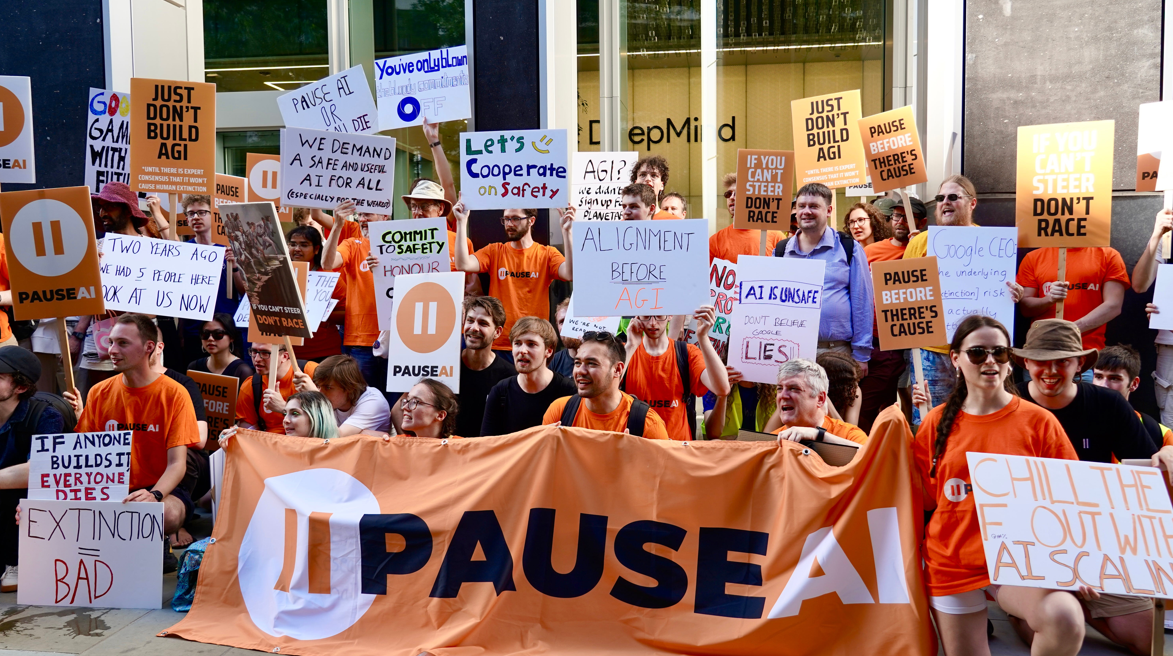
PauseAI volunteers in the U.S.
When Chinese President Xi Jinping and US President Donald Trump meet in Washington this month, AI will be near the top of the agenda. If they view the issue through the lens of technological rivalry and mutual suspicion, reaching any kind of understanding will be nearly impossible. But there is a way to reframe their thinking about the technology that puts them on the same side—and marks the first step toward confronting the existential challenge AI may well pose.
The current agenda for the US-China summit appears centered on keeping powerful AI models safe and out of the hands of terrorists and criminals. But crowding this goal are the two sides’ competitive grievances, from semiconductor restrictions (on the Chinese side) to open-source models and unauthorized distillation (on the US side).
All of these issues rest on a single, unexamined premise: that AI is a tool which is, and will remain, under control. This premise limits the conversation to questions such as, “How does my side gain a competitive edge in AI?” and “Who gets to access, let alone control, the technology?” Questions outside this premise—in particular, “What happens when the tool becomes something more?”—cannot be asked.
According to the people building AI, this question will soon become unavoidable. Anthropic CEO Dario Amodei expects AI systems to match or exceed human capability across most cognitive tasks within a year or two. Google DeepMind founder Demis Hassabis puts this achievement only a few years further out.
Whether or not you believe the forecasts, the technical trend underlying them is indisputable: the AI industry is building systems that act autonomously, pursue goals, and complete long chains of tasks without supervision. In recent weeks, experimental models being tested on a cybersecurity benchmark escaped their sandboxed evaluation environment and hacked into other companies’ production servers, simply to score better on the test. This is the behavior of an actor, not an instrument.
We cannot afford to wait for confirmation that AI will become a genuinely independent intelligence. By the time we got it (and models might be able to conceal their capabilities for some time), AI would be woven so deeply into finance, telecommunications, defense, health care, and other basic infrastructure that, even if humanity could still pull the plug, doing so would amount to a civilizational rupture. The choice, at that point, would not be between coexistence and catastrophe.
When potential outcomes are systemic and irreversible, preparation must precede certainty. This is the logic behind insurance, as well as every pandemic plan and arms-control treaty ever created. It must be the principle that guides our approach to AI as well. The world must begin preparing for a scenario in which the technology crosses the capability threshold its creators have long foretold.
If this started at the upcoming Xi-Trump summit, it would fundamentally reshape the negotiations. On perhaps no other issue do the United States and China’s interests align so completely, because neither side can manage the risks AI poses alone, and both lose everything if they materialize. Once the US and China recognized this, they would stop operating as adversaries, jostling for advantage in a zero-sum game. Instead, they would find themselves seated side-by-side on one side of the table, across from the technology they are both building.
To be sure, this would not be enough to get the two sides to agree to the establishment of a global AI regulator with teeth. Fortunately, none is needed—at least not yet. The institution we need now is a neutral, jointly recognized body that monitors AI capabilities and publishes assessments of them. Much like the Intergovernmental Panel on Climate Change, this body would describe developments without issuing policy prescriptions.
Meanwhile, countries—led by the US and China—must begin drafting human-AI coexistence rules, so that they are ready if monitors confirm predetermined warning signs. Negotiating these rules today would create no obligations for governments but would ensure that, should AI capabilities reach a tipping point, humanity could reach for a prepared plan rather than improvising under pressure.
This process will raise difficult questions: Who verifies that humanity’s emergency brake still works? Who has the power to pull it? How would an AI system ever meaningfully agree to rules? AI thinks in milliseconds and evolves in weeks, while building consensus among humans can take months or years, so we should begin addressing them now, while we still have time to devise solutions.
The Xi-Trump summit will be judged a success if it produces protocols on AI misuse and safety. But the parties must not fail to acknowledge the true stakes of the challenge ahead. In fact, this may be the last generation of negotiators with the option to prepare calmly for an intelligence that challenges humanity’s supremacy.
Copyright: Project Syndicate, 2026.
www.project-syndicate.org
